Editor's Pick
Could Trump's electoral defeat make the world less secure?
Why do some resent garment workers' demand for a living wage?
Padma Barrage: Why Bangladesh needs it and the challenges ahead
US midterms: Why Bangladesh has a stake in the result
A 93rd birthday tribute / How Amartya Sen changed the way we understand development


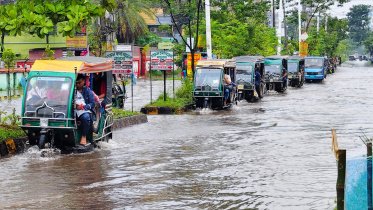
For the second time in eight days, large parts of Khulna city went under water after overnight rain, raising fresh questions about the effectiveness of Khulna City Corporation's (KCC) years-long waterlogging mitigation project despite significant investment in drainage infrastructure.
Roads, alleys and low-lying neighbourhoods remained inundated after 73mm of rainfall was recorded between 6:00pm yesterday and 9:00am today, according to the Khulna Meteorological Office. Eight days earlier, 30mm of rainfall had submerged large parts of the city.

The latest flooding has renewed scrutiny of KCC's waterlogging mitigation project. Over the past five and a half years, the project has included the excavation of seven canals and the construction or renovation of more than 200 drains. Yet even moderate rainfall continues to inundate many parts of the city.

Residents and environmental experts say the project failed to adequately consider Khulna's natural drainage system, canal carrying capacity and long-term urban expansion. They argue that narrowing natural canals and converting them into concrete drains has significantly reduced the city's ability to discharge stormwater.
Alamgir Sheikh, a resident of Kabir Bottola, said the ground floor of his home now goes under water whenever it rains after a nearby road and drain were raised about a year ago.
"The road and drain were raised, but no proper outlet was kept for rainwater from surrounding houses to drain away. Even after moderate rain, water remains trapped for days," he said.

Standing in knee-deep water outside his grocery shop at Basthuhara Kitchen Market, trader Abdur Rob said his sales fall by nearly half during the monsoon because customers avoid flooded markets. He also criticised delays in repair work on a nearby drain, saying they had worsened the situation.
Advocate Shamima Sultana Shilu, a Khulna-based civic activist, said five classrooms at her educational institution were inundated after the latest rainfall.
She questioned the design of the city's drainage system, saying fully concrete-lined drains have become difficult to maintain, allowing plastic waste and other debris to accumulate and obstruct water flow. The city corporation also lacks modern equipment to clean the drains effectively, she said.
Environmentalists say the crisis stems from poor planning rather than a shortage of drains.
Mahfuzur Rahman Mukul, Khulna divisional coordinator of the Bangladesh Environmental Lawyers Association (Bela), said at least 13 natural canals, including the Taltala Canal, have been converted into narrow concrete drains over the past 15 years.
"Canals that were once 60 to 100 feet wide have been reduced to drains only 12 to 13 feet across, drastically reducing their capacity to carry stormwater," he said.
Gouranga Nandy, chairperson of the Centre for Environment and Participatory Research (CEPR), said Khulna's recurring waterlogging reflects a failure of urban planning.
"Building new drains alone will not solve the problem unless natural canals are restored and the drainage network is properly connected to surrounding rivers," he said. He warned that climate change is likely to worsen the situation.

KCC says it has significantly expanded the city's drainage network under its ongoing waterlogging mitigation project. According to the civic body, the city now has around 1,165 kilometres of drains, including 169 covered drains with a combined length of 147 kilometres built under the current project.
Chief Conservancy Officer Md Anisur Rahman said drains are cleaned regularly, but continuous rainfall has hampered maintenance because removed silt is washed back into the drains.
He acknowledged that maintaining the covered drains has become difficult as KCC lacks specialised cleaning equipment and workers have to remove heavy concrete slabs manually before clearing accumulated waste.
He said modern drain-cleaning machinery would be procured under the ongoing project, which is expected to make maintenance more effective.
 For all latest news, follow The Daily Star's Google News channel.
Comments
Related News
Fire breaks out at cotton warehouse in Gazipur
US midterm polls expose growing voter backlash against data centres
Man hacked to death inside shrine in Munshiganj
Former Krishi Bank officer Mohsina Ahmed passes away
Continue reading at The Daily Star
This story was collected by Khulna Info and links back to the original publisher.