Editor's Pick
Opinion / Washington’s tariff move: What is at stake for Bangladesh’s economy?
Getting our industrial policy right before LDC graduation
The Rohingya genocide verdict and the strategic calculations of the US and China
How Sufism and shrine veneration shaped Muslim society in the Bengal delta


Khulna’s narcotics market is hardly a mystery to law enforcers. They know where drugs are sold, the supply routes, and have identified hundreds of suspected dealers.
Yet the trade continues.

Residents allege that despite arrests of couriers, low-level dealers and users, those financing and controlling the business remain beyond the reach of law enforcement.
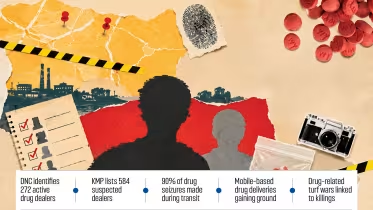
In August, in a report to the Prime Minister’s Office, the Department of Narcotics Control (DNC) identified 272 active dealers in Khulna city and sought instructions to curb the trade.
The DNC’s divisional intelligence office has a separate list of 10 top-level traders, 30 wholesalers and 43 retailers, while the Khulna Metropolitan Police (KMP) maintains a list of 584 suspected dealers. It could not be verified whether there are overlaps between the three lists.
An examination of DNC intelligence, police records and information from law enforcement officials reveals how the narcotics trade operates in Khulna. Drugs are transported by couriers through multiple districts and distributed through mobile networks before ultimately being sold in the retail market.
SK Ifthekhar Mohammad Umayer, deputy director of Khulna’s DNC divisional intelligence office, said, “Despite limited manpower, we are conducting regular operations and awareness programmes to discourage drug use.”
However, another official claimed that many operations could not be carried out in Khulna, as the DNC and the police were afraid for their safety.
The DNC report identifies Satkhira and Jashore as major corridors through which phensedyl and yaba enter Khulna. The agency has also identified routes through Jhenaidah, Chuadanga, Meherpur and Kushtia, as well as through the Benapole and Bhomra border areas.
Cannabis makes its way into Khulna mainly from northern districts through Jashore, with officials also mentioning supplies originating from Brahmanbaria. Sources familiar with the trade also identified Narail as an important corridor for yaba.
A DNC official familiar with the matter said that recent arrests indicate that drug traffickers are recruiting more women now as couriers because they are less likely to be searched at checkpoints.
Couriers earn between Tk 15,000 and Tk 20,000 for transporting drugs from Satkhira to Khulna, while consignments to Dhaka can pay two to three times more, he said.
Drugs were also transported in trucks, private cars, microbuses and motorcycles, according to a police official in Satkhira.
He cited the case of Anis, a rental car driver arrested by RAB (now SRB) in Bagerhat while allegedly transporting 5,000 yaba pills to Khulna for Tk 30,000.
According to DNC officials, of the drugs recovered in Khulna, 90 percent were seized during transportation, and the rest during raids on houses or other premises.
As consignments were frequently moved between locations, arrest of carriers did not necessarily lead to those financing or organising the shipments, according to them.
Alongside yaba, cannabis, heroin and phensedyl, misuse of opioid painkillers and cheaper cough syrups -- reportedly reaching Khulna through Satkhira and Jashore -- is also a growing concern, according to a DNC official.
A phensedyl bottle can cost between Tk 4,200 and Tk 4,500 in Khulna’s retail market, but other codeine phosphate-based cough syrups can be bought for half the price, according to sources.
Yaba sells for Tk 300 to Tk 350 apiece. Those who sell in the retail market after buying from criminal networks earned profits of Tk 150 to Tk 175 per pill.
The DNC report identifies selling points that include residential neighbourhoods, markets, transport hubs and industrial areas, as well as locations near jute mills, educational institutions, railway stations and river ghats.
 For all latest news, follow The Daily Star's Google News channel.
However, the retail distribution system has changed considerably in recent times, according to officials and local sources. Buyers can contact sellers through mobile phones to get small consignments delivered by motorcycles and rickshaws.
Sources said criminal networks were using this arrangement, using code words to conceal their transactions, instead of depending entirely on known selling points.
People from low-income backgrounds such as rickshaw pullers and labourers are reportedly being drawn into the trade through promises of quick earnings.
Local sources alleged that drug proceeds helped finance criminal groups and secure political and administrative influence. However, transactions linking drug profits to these activities could not be independently verified.
SM Shafiqul Alam Mona, president of Khulna metropolitan BNP, said there was hardly any ward in the city free from drug trading.
Khulna Superintendent of Police Sarker Omar Faroque said drug-related disputes, including conflicts over selling points, were linked to many recent killings.
According to DNC Khulna office data, 96 drug-and-arms cases, involving 109 accused, were filed between January and October this year. During the period, officials seized 4,775 yaba pills, over 36 kg of cannabis, 109 litres of phensedyl and 15 codeine phosphate-based syrup bottles, as well as firearms and ammunition.
Between August and October 2026, the KMP arrested 190 individuals in 166 drug-related cases.
KMP Additional Commissioner (Crime) MM Shakiluzzaman said the police were regularly conducting raids and arrests, but families have a role in preventing young people from using drugs.
However, the information provided by the agencies does not highlight how many of the identified top-level traders, wholesalers and financiers have been arrested or prosecuted.
While officials point to their continuing operations, residents question why those controlling the trade remain untouched.
Mizanur Rahman Babu, president of the Communist Party of Bangladesh’s Khulna metropolitan unit, alleged that sections of the previous political establishment used to control the business, and now people connected to the current political leadership maintain links with drug traders.
He questioned how those involved continued operating despite being known to the authorities.
Comments
Related News
Anti-terrorism case: Ex-Hasina aide, 2 others sent to jail
One killed, another missing in BNP factional clash
Probe into attacks on Star, Prothom Alo gets ninth extension
Nature Quest / Paradise in Peril
Over 74,000 families covered under Family Card by September
Continue reading at The Daily Star
This story was collected by Khulna Info and links back to the original publisher.